

Last week I posted that the capital needed for the AI buildout is massive and that the only historical analogue is the Railway buildout in the 1800s.1
AI capex should land at ~2.4% of GDP this year per Goldman Sachs.2
That’s significantly higher than the peaks of: the highway buildout, the space race, the telecom boom fueled by the internet in the 1990s, and the shale revolution in the 2000s. It’s similar to peak spend on electrification in 1930 when we spent 2.6% of our GDP on building the electrical grid.3
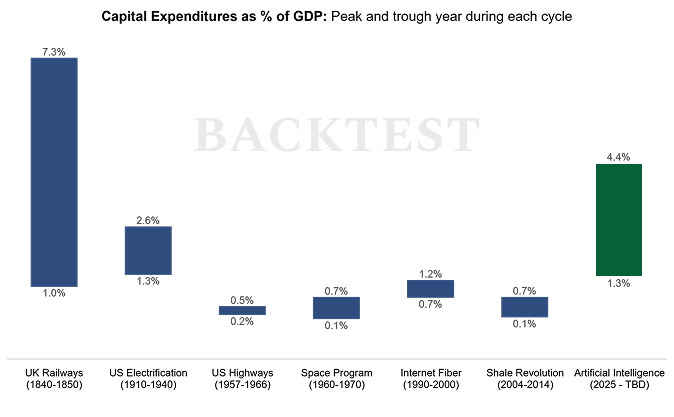
But projections (and the booming equity markets, from upcoming IPOs by OpenAI and Anthropic to Google’s recent $80 billion equity raise 🤓) say we’re just getting started on AI capex. AI capex might reach 4.4% of GDP or higher by 2030.4
There’s only one period that beats that.
It’s the 1840s Railway Mania in the UK when capital deployed to railway projects in a single year reached an all-time record of 7.3% of GDP.5
That’s the story we’re going to tell in episode 2. After covering the technological breakthrough of steam-powered locomotives in episode 1, we’re going to dive into the rip roaring story of the time the UK went bananas for railways.
Coming soon to your favorite podcast player.
“The Apollo Program, the buildout of highways, electrification, and telecom were massive spending programs...” (link to post).
Tracking Trillions: The Assumptions Shaping the Scale of the AI Build-Out by Goldman Sachs Global Institute; May 1 2026 (link).
Data sources include St Louis FRED Private Public Utility Construction for Capex and Measuringworth.com for GDP for electrification; US DOT for highways; planetary.org for the space program; St. Louis FRED Private fixed investment in equipment and software data set for internet fiber; IFRI for the shale revolution; and St Louis FRED’s GDP Dataset for GDP after 1947. Artificial intelligence estimates assume 2.5% GDP growth through 2030.
2030 projection by Goldman Sachs Global Institute assumes 2.5% GDP growth per year for the remainder of the 2020s. Check out their full piece for details on their forecasting methodology (link).
Collective hallucinations and inefficient markets: The British Railway Mania of the 1840s by Andrew Odlyzko, Professor Emeritus, School of Mathematics at the University of Minnesota .
Excited for the episode. Heard Derek Thompson talk about it a few months ago and def want to go deeper