

Every transformative technology of the last two centuries led to a market boom that inflated a bubble. Despite the promise of the technology being real, most of those bubbles ended in a market bust. Underlying every single boom was intense competition for the capital funding it. That is to say, the deciding factor is, was, and will always be where capital gets allocated. The AI buildout is no different, and the fierce competition for capital is playing out in markets right now.
Few people are better placed to help us understand these dynamics than Will Carpenter, Co-Head of Private Equity Principal Investments at the Teacher Retirement System of Texas. Will has taught finance and market history at the University of Texas McCombs School of Business. More importantly, he’s an old friend, a fellow student of markets, and was one of the first Backtest listeners.
In this guest post, Will argues that the technology alone won’t decide the fate of the AI boom. Two other forces will. The first is the competition for capital, as hyperscalers, AI labs and governments all draw on the same pool of global savings at once. The second is a set of natural brakes, energy and people, that pace the build no matter how much money is available. Together they force choices Washington has put off for decades. Along the way, Will connects a bond market in Tokyo to a data center fight on the Mississippi, and our railway series to today’s headlines.
Let’s get into it.
In the summer of 2007, I was a college student on one of Britt Harris’s Aggies on Wall Street trips to New York. One of the people we met was Larry Fink, who gave us two pieces of career advice that shaped my early years in finance. First, read The Wall Street Journal every day and The Economist every week. Second, understand technology no matter what industry you work in, because the big shifts in technology can reshape everything. I still read as much of the Journal as I can each day, and the second piece of advice has only grown more important.
Nineteen years later, those two pieces of advice converged on a single page. On Wednesday, Fink wrote in the Journal that the AI buildout, colliding with record government borrowing, has produced “the biggest competition for capital I have seen in 50 years in finance.” Within days, the markets offered a live demonstration of what that competition looks like. AI stocks stumbled, and the most indebted borrowers in the buildout took the worst of it. By Sunday morning, James Mackintosh’s Streetwise column in the WSJ was reaching for John Templeton’s warning that the four most dangerous words in investing are “this time it’s different.”
Few people doubt that AI is among the most transformative technologies of the past century. As Ruchir Sharma observes in a sweeping new essay in Foreign Affairs, AI is spreading faster than the great technologies that came before it. Within four years of ChatGPT’s release, roughly 30% of Americans were already using AI, about five times the share that had adopted smartphones, the internet or electricity at the same point in their rollouts. Count me among the enthusiasts. I have never been more excited about the possibilities of AI, as my colleagues can attest after watching my delight at what Microsoft’s Copilot can now do in building decks and analysis with Anthropic’s Claude Opus 5.5 under the hood. Yet Sharma also reminds us of a centuries-old script. Every truly revolutionary technology of the past two hundred years has inflated a major market bubble, precisely because the promise was real. As he puts it, “a bubble can be characterized as a good idea taken too far.”
AI may well prove to be the most transformative technology of all time. But what may set this cycle apart is not only the technology itself but the moment in which it arrives, colliding with record government debt, aging populations and a world that is rearming. To be clear, capital isn’t scarce yet. But for most of my career, it was the one input that never seemed to run short. Global savings were abundant, central banks were buying bonds, and the binding constraints on great ventures were ideas, talent and, more recently, chips. That era is shifting, and it may be ending. The AI build could be converging with what Ray Dalio, in How Countries Go Broke, describes as the late stages of a big debt cycle - debt and debt service grow faster than the incomes needed to pay them, and lenders begin demanding more to keep lending. The structural flows that kept capital cheap for two decades are already shifting. If capital becomes scarce again, its price, the long-term interest rate, will be the variable that ties together a data center in Iowa, a pension fund in Tokyo, a defense budget in Washington and a welfare state in London.
Let me be clear about what this essay is not. It is not a call that the boom has ended. Sharma doesn’t put a date on it either, and anyone who claims to know the timing is guessing.
My argument is that the fate of the AI boom will be decided not only by the technology alone, but also by two other forces. The first is the competition for capital. Governments, hyperscalers and AI labs are all drawing on the same pool of global savings at the same time, with the bond market as referee. The second is a set of natural brakes, chiefly power and people, that have the potential to pace the build no matter how much money is available, or what is or isn’t done with regulation. And when capital becomes finite, it ultimately forces choices. An AI build increasingly financed with debt is now colliding with political decisions Washington has deferred for decades - persistent deficits, an aging population and a long-overdue defense buildup. This cycle is forcing governments, companies and communities to choose among domestic, geopolitical and economic goals that are more intertwined than at any time I can remember. Pull on any one of these threads, and you find it tied to the others.
All In
The AI race is already reshaping the economic order, and not only in Washington and Beijing. In the United States, growth is being carried by Big Tech’s investment in AI and by consumer spending lifted by an AI-dominated stock market. Nearly all of the ten largest stocks in the S&P 500 are major AI players. Together they make up nearly 40% of the index and around half of its returns this year. Michael Cembalest of J.P. Morgan, who as I’ve written before is hands down my favorite market strategist, puts it even more starkly in his latest Eye on the Market. A basket of 42 AI stocks has accounted for 60% to 80% of S&P 500 earnings growth, price returns and capital spending since January 2024, and technology investment now accounts for roughly a third of U.S. GDP growth.
China spends far less on AI but leans on it just as hard. Net exports, mainly of AI-related goods, account for about a third of its growth. Across the rest of Asia, the frenzy runs all the way down the AI stack, from memory makers to chip foundries to the factories that assemble servers. South Korea’s stock market grew from $1.5 trillion at the start of 2025 to more than $5 trillion this summer on the back of Samsung and SK Hynix. Chip exports have pushed Taiwan’s growth toward double digits in some quarters, and Japan’s Kioxia rose more than 45-fold in a year. Beneath the leaders sit Malaysia, Mexico and Vietnam, which host data centers and server assembly, and beneath them the miners supplying copper, nickel and lithium. Countries outside the stack, including much of Europe, India and the Philippines, may find it harder to attract capital.
It is hard to think of another period when markets depended so heavily on a single sector. Private spending on data center construction is up about 50% from a year ago, while spending on every other kind of U.S. building is down. Scale frames everything else. Columbia’s Stijn Van Nieuwerburgh estimates U.S. investment in AI infrastructure at $10.3 trillion from 2025 through 2032, averaging about 3.6% of GDP a year. That is larger, relative to the economy, than the railroads, the interstates or the fiber build of the 1990s.
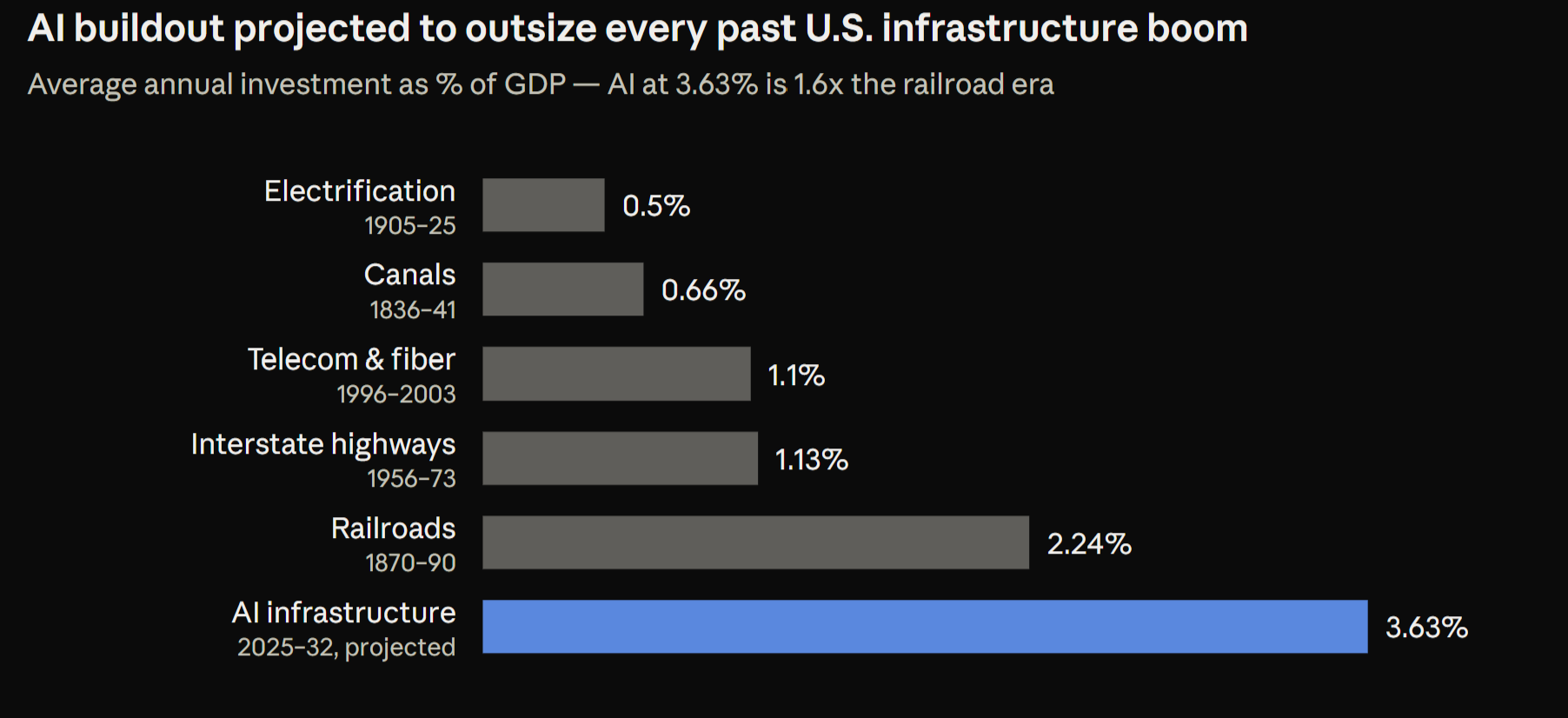
Measured more broadly, Sharma estimates that total tech spending on plants and equipment has reached about 6.3% of GDP, above the 6.0% peak at the height of the internet bubble. Amazon, Microsoft, Alphabet and Meta alone are on track for roughly $725 billion of capex this year, and analysts expect more than $1 trillion in 2027. So far, that spending has been strong enough to carry the global economy through tariffs and a war in the Middle East. The corollary is less comfortable - an economy leaning this hard on one sector inherits that sector’s risks.
The “E” Problem
The bulls’ strongest argument is earnings. Unlike the dot-com startups, today’s AI leaders are enormously profitable. But so were the giants of the late 1990s. Cisco, Oracle and Qualcomm made real money, and the tech sector’s earnings growth then, about 22% a year, matched the pace of the current decade. Strong earnings don’t rule out a bubble. However, in a bubble, earnings themselves are often inflated, and there are two reasons to think today’s are.
The first is that one company’s capex is another company’s revenue. As Mackintosh points out, the makers of everything a data center needs, from chips and memory to cables, cooling and turbines, have been able to raise prices as volumes soar. That spending falls sharply once the buildings are finished. Markets seem to understand this. Nvidia’s forward price-to-earnings ratio has fallen from 23 to 15 even as its shares rose, which means analysts’ earnings estimates have climbed faster than the stock. Higher interest rates explain part of that, since they shrink the present value of every future dollar of profit. When I taught finance at UT Austin’s McCombs School of Business, one of the first lessons I tried to get across was that a multiple is the market’s verdict on how durable earnings are, not just how large they are. Investors pay a high multiple for earnings they expect to persist and grow, and a low one for earnings they suspect are near a cyclical peak or at risk of disruption. That is why steelmakers and memory-chip makers often look cheapest at the top of their cycles. A shrinking multiple on rising profits is the market quietly saying it doubts today’s earnings will last, or that growth will taper once the buildout slows. As Rob Almeida, a strategist at MFS Investment Management, told Mackintosh, “the market doesn’t have a P problem, it has an E problem.”
The second is circularity. In 2025, Nvidia agreed to invest up to $100 billion in OpenAI. OpenAI committed to about $300 billion of cloud capacity from Oracle, and Oracle buys Nvidia chips to deliver it. A subtler loop runs through the hyperscalers. They invest in AI labs, the labs buy their cloud services, and the hyperscalers then book gains on their rising lab stakes as “other income,” which has accounted for roughly a quarter of their earnings growth this year. Meanwhile, the labs price many of their services below cost to win share. Both distortions point the same way. Today’s earnings depend on spending that has to keep growing, which makes the financing behind that spending the real question.
Who Pays
So who is paying for the build? Until recently, the hyperscalers paid for it themselves, out of enormous cash flows. No longer. Of the four largest, only Microsoft still generates meaningful free cash flow after capital spending. Alphabet’s turned negative in the second quarter for the first time since its 2004 IPO, Amazon’s trailing figure has slipped below zero, and Meta’s is barely positive. As an aside on my excitement for the technology itself, I have been quite happy with the help from my Muse agent, Iris, this past week. But the point is that the companies that were among the world’s largest buyers of financial assets have become net issuers of debt.
The equity side is just as unprecedented. Venture investors put a record $510 billion into startups worldwide in the first half of this year, more than in all of 2025, and OpenAI and Anthropic alone raised about $217 billion of it. That capital eventually has to be recycled through public markets. SpaceX’s IPO in June, at roughly $1.75 trillion, showed the window is open, and OpenAI and Anthropic are expected to follow. Those listings will ask public investors to absorb trillions of dollars of private valuations just as Treasuries and data center bonds compete for the same savings. A stumble would ripple back through every fund and corporate backer that has marked those stakes up.
The debt is harder to see. Moody’s found that the five largest hyperscalers had signed $662 billion of data center leases that have not yet started and so don’t appear on their balance sheets, more than their adjusted debt. Much of the rest runs through joint ventures and special-purpose vehicles whose bonds lean on the parent’s promise to pay rent - rent that, as a Fitch director recently cautioned, doesn’t start until the building is finished. Borrowing costs have moved the way relentless supply would predict, with high-yield data center spreads widening since June.
Increasingly, the marginal buyer is the life insurance industry, flush with annuity money that must be invested in long-dated, investment-grade paper. Private placements have grown from 18.3% of insurers’ bond holdings in 2021 to 23.4% in 2025, and state insurance regulators have opened inquiries into whether the ratings on data center debt hold up. Some insurers, including AXA, are already stepping back.
Which brings me back to Fink, the source of that old career advice. His prescription for the capital crunch is to scale the financing beyond today’s bespoke deals. A former mortgage trader, he argues that securitization could do for computing infrastructure what it did for mortgages, and that America needs more investors, since roughly four in ten Americans own no stock at all. I’ll confess his comments made me chuckle. The answer to too much bespoke AI debt concentrated among too few lenders is to package it up and sell it to more people, including retail investors? It brought to mind the mortgage machine of the mid-2000s. To be fair, Fink’s argument is about broadening ownership of the growth, and securitization did eventually make American housing finance the deepest market in the world. It also gave us 2008 along the way. Both things can be true.
The Competition for Capital
To see why borrowing costs matter so much now, go back twenty years. In 2005, Fed governor Ben Bernanke described a “global saving glut.” Fast-growing Asian economies and oil exporters had become large net lenders, pouring their surplus savings into U.S. assets and holding down long-term interest rates worldwide. For most of the two decades since, that arrangement held - the world saved, America borrowed and long rates stayed low. After 2008, central banks bought trillions of bonds themselves.
That world is fading. The great savers of the past two decades are becoming spenders, and the reasons are structural rather than cyclical. Populations are aging, geopolitics is fragmenting, governments are rearming and rebuilding their energy systems, and the hyperscalers that once sat on mountains of cash are now borrowing. Fink is right that this is the biggest competition for capital in half a century. What makes it so consequential is that every participant faces a choice between goals that pull against each other.
Demography is the slowest of these forces and the hardest to reverse. Workers in their peak earning years save, and retirees spend down what they saved. For decades, the baby boomers of the West, Japan and China were a powerful source of savings that helped keep rates low. As that generation retires, the flow reverses. Pension funds shift from accumulating assets to paying benefits, and governments spend more on health care and pensions. The economists Charles Goodhart and Manoj Pradhan call this the great demographic reversal and argue it will push interest rates higher over time. It is a headwind no central bank can easily offset.
Geopolitics is redirecting the flows as well. When Western governments froze roughly $300 billion of Russia’s central bank reserves in 2022, every reserve manager outside the Western alliance took note. China’s reported holdings of Treasuries have fallen to roughly half their 2013 peak, the lowest level since 2008, while its central bank has been steadily buying gold. The official figures likely overstate the retreat, since some Chinese holdings sit in custodial accounts abroad. But the direction is clear, and the largest saver in the developing world is no longer a reliable marginal buyer of American debt.
Japan, long the world’s largest creditor, is choosing domestic growth over exporting its savings. This summer, Prime Minister Sanae Takaichi called on households and pension funds, including the $1.8 trillion Government Pension Investment Fund, to invest more at home, and Japan’s 10-year yield has crossed 3% for the first time since 1996. That leaves less Japanese money for Treasuries, and for everything else abroad.
Colleagues have sometimes asked why I spend so much time watching macro variables that seem distant from our portfolio, like the yen or Japanese bond yields. The reason is that the interconnections run deeper than most people perceive. SoftBank, OpenAI’s largest outside backer, is on track to have invested about $64.6 billion in the company, funded largely with debt - a $40 billion bridge loan, loans secured by its OpenAI shares, a record ¥1 trillion retail bond sale in Japan and $11.1 billion of dollar and euro bonds with coupons as high as 9.75%. OpenAI, in turn, has committed up to $22.4 billion to CoreWeave on top of its roughly $300 billion contract with Oracle. When Japanese savers can earn more at home, the capital behind SoftBank gets more expensive, and that cost travels through OpenAI to the data center operators and their bondholders. A move in Tokyo’s bond market is, at a few removes, a move in AI credit.
Sebastian Mallaby draws that same line, from Japanese bond yields to SoftBank and OpenAI, near the end of a recent conversation on the Backtest podcast, co-hosted by my friend Matt Harris. Matt is Britt’s son, and we first met on that same 2007 trip to NYC. He was in the room when Fink gave us his advice, and he has been a good friend ever since. I first met Mallaby a few years ago at a Council on Foreign Relations event in Menlo Park. Few writers have his range. He has written authoritatively on hedge funds, on Alan Greenspan, on venture capital in The Power Law and, most recently, on the founding of DeepMind in The Infinity Machine. The last two are worthwhile reads for anyone trying to understand this moment, and the episode, which frames today’s boom against the railroads, is well worth an hour of your time.
Others are making the same turn. Korea is reinvesting the profits of its memory boom at home through President Lee Jae Myung’s “Three Mega Projects,” which call for Samsung and SK to invest as much as $1.3 trillion over a decade. Canada’s Prime Minister Mark Carney has pressed the country’s pension funds to invest domestically, and they committed close to C$100 billion around September’s Canada Investment Summit, even as pension executives warned against political interference with their fiduciary duty - a tension anyone who manages public pension money will recognize. The Gulf’s sovereign funds, which manage an estimated $4 trillion to $6 trillion, face rising needs at home since the Iran war began, and Saudi Arabia’s PIF has reportedly cut its international allocation from 30% to 20%.
Energy is a claimant of its own. Every major region now treats energy security as a strategic priority - Europe since Russia’s invasion of Ukraine cut off its cheapest gas, and this year Asia’s importers and the Gulf’s exporters alike after the disruption in the Strait of Hormuz. That means building generation, storage, pipelines and grids at home rather than relying on fuel that has to pass through someone else’s chokepoint. And it comes just as any country hoping to host the AI build needs a historic step up in power. In the United States, electricity demand was essentially flat for nearly two decades and is now climbing, and utilities are entering their largest investment cycle in decades. Every power plant, pipeline and transmission line needs financing from the same pool of long-term savings.
The United States government, meanwhile, is choosing to keep borrowing. The Congressional Budget Office projects a deficit of about 5.8% of GDP this fiscal year, against a 50-year average of 3.8%, with net interest topping $1 trillion and federal debt at a record $40 trillion. Put those choices side by side and the arithmetic is unforgiving. The Treasury, the hyperscalers, the AI labs, the utilities and governments from Tokyo to Ottawa all need unprecedented sums in the same few years, just as several of the largest pools of savings that once absorbed American debt are being steered home. When supply rises and marginal buyers step back, the remaining lenders demand more to lend for longer. Economists call that the term premium, and after years near zero, it is rebuilding.
This is the trade-off at the center of the cycle - a dollar of Treasury issuance and a dollar of data center debt compete for the same savings. Mallaby made the point bluntly on CFR’s The Spillover in August. Textbook public finance says heavy government borrowing crowds out private borrowing, and he argued that is exactly what is happening, with Treasury issuance raising rates for the private sector and slowing the AI build that Washington says it wants to win. When the Treasury Secretary suggested that AI companies issue fewer long-dated bonds, Mallaby’s view was that the logic ran backward. Cembalest, for his part, ascribes the recent climb in 10-year yields to sticky inflation, stronger-than-expected growth and hyperscaler debt issuance. The AI build has grown large enough to help move the price of the world’s benchmark safe asset.
The loop closes on itself. The AI build competes for capital, and it also feeds the inflation that keeps rates high, as data centers bid up memory chips, transformers, turbines, electricians and power. Higher prices keep the Fed tight, and tighter money raises the cost of financing the next data center. What the data cannot tell us is how much of the rise in long-term yields comes from AI borrowing rather than oil, deficits, demographics or Japan’s exit from ultra-low rates. Anyone offering a precise split is guessing. I think these forces compound rather than offset.
A Week as a Window
One point about how bubbles end is underappreciated. They rarely burst because the fundamentals suddenly change. Earnings can stay strong even as prices fall. The more consistent trigger is liquidity. Money becomes harder or costlier to borrow, lenders grow less willing to lend at any price, and the problems surface first in the debt markets before spreading.
That is roughly how this past week unfolded. A hotter-than-expected inflation report revived talk of Fed hikes, days after the 10-year Treasury yield touched its highest level since 2002. The most leveraged borrowers cracked first. CoreWeave, whose growth has been financed heavily with debt, lost about a quarter of its value as its bonds slid, and D.A. Davidson’s Gil Luria called the neoclouds “the subprime tranche of the AI trade.” Chip stocks followed, falling eight sessions in a row for the first time since 2008. When Nvidia, CoreWeave’s supplier and one of its largest investors, publicly vouched for the company, the stock fell further. Walter Bagehot described that dynamic in Lombard Street in 1873:
“Every banker knows that if he has to prove that he is worthy of credit, however good may be his arguments, in fact his credit is gone.”
Two details struck me more than the price moves. Days before the selloff, the chief executives of Broadcom and Intel both warned that capital, not chips or power, may now be the binding constraint on AI. And despite the hot inflation print, long-dated Treasuries rallied, as if the bond market saw the AI wobble as a growth risk large enough to outweigh an inflation surprise. If that reading is right, it says a great deal about how much of the economy’s momentum now rests on a single spending cycle.
One week is not a trend, and I would not read too much into any five trading days. What matters is what the week revealed about the wiring. Stress traveled in the order history would predict, from the cost of money to the most leveraged credits to equities. On a multi-year horizon, that sequence deserves more attention than any single day’s market moves.
Is This 2008?
Anyone who has taught market history, as I used to as part of my course at UT, knows October’s reputation. The Panic of 1907 broke in October. So did the Crash of 1929, and Black Monday on October 19, 1987. October 2008 was the worst month for stocks in more than two decades. Mark Twain had the right answer back in 1894, in Pudd’nhead Wilson. “October. This is one of the peculiarly dangerous months to speculate in stocks. The others are July, January, September, April, November, May, March, June, December, August and February.” The joke is the point. October’s record is a coincidence, not a law, and on average September has historically been the weaker month for stocks.
A week like this one invites the obvious question, and I think the answer is probably not, at least not in the way people fear. The case for calm is stronger than the headlines suggest. The largest hyperscalers came into the boom with little debt, and even after this year’s record issuance, their borrowing remains modest relative to earnings. The financial system is also far less fragile than it was. Apollo’s chief economist, Torsten Slok, recently pointed out that the big investment banks of 2008 ran leverage above 30 to 1, while banks today run closer to 10 and the business development companies behind much of private credit are legally capped at 2. Just as important, much of the AI debt sits with insurers whose liabilities are long-dated annuities, not deposits that can flee overnight. And many data center deals are structured so that a creditworthy tenant signs the lease before the first chip is bought.
But the case for calm has limits. The system’s strength is an average, and crises start at the edges - an Oracle heavily dependent on a single customer, neoclouds financing fast-depreciating chips with five-year debt, joint ventures whose rent doesn’t start until the power is on. Much of the exposure sits in private markets where no one can see it clearly. Eighteen years after 2008, the promise of regulators who could map systemic risk in real time remains unfulfilled, a point Mallaby makes with some exasperation. And AI has become a single factor running through equities, credit and venture capital at once, so the usual hedges may not hedge. When losses hit, leveraged investors sell what they can, not what they should.
Is OpenAI, then, too big to fail? Mallaby’s answer, implicitly, is no. On The Spillover, he treats trouble at OpenAI as a live scenario rather than an unthinkable one, walking through how a stumble there could cascade to Oracle, which is building enormous capacity against OpenAI’s roughly $300 billion compute commitment while OpenAI’s revenue remains a fraction of the annual payments it has promised. Nothing is inevitable in a market this dynamic, including the survival of any single company, however large. OpenAI sits at the center of commitments running to Oracle, CoreWeave, Nvidia, Microsoft and SoftBank, which is exactly why the question deserves a serious answer rather than a reflexive one. To be clear, I’m certainly not predicting a failure, only arguing that investors should know who is exposed, and to whom.
Natural Brakes
AI is becoming the organizing technology of the next global order, and much of the policy debate turns on how fast the frontier should be allowed to advance. At a recent Council on Foreign Relations dinner in Austin, “AI, National Security, and the Next Global Order,” held not for attribution, I found myself arguing that this debate often treats pace as a choice policymakers get to make. In practice, the frontier is already being paced by limits I see every day as an investor - power, supply chains, permitting and local political resistance. Those constraints don’t wait for a policy decision.
A recent a16z podcast with Databricks CEO Ali Ghodsi sharpened that point for me. Ghodsi, who puts today’s existential risk from AI “close to zero,” offers a useful test for whether recursive self-improvement is actually underway. Each new frontier model would need materially fewer chips and less training time than the last while still getting smarter, again and again. Today the opposite is happening. On the same episode, a16z’s Sarah Wang, a former Morgan Stanley colleague of mine, noted that the cost of a frontier training run has gone from roughly $100 million to $1 billion to an estimated $5 billion to $10 billion. Far from escaping its physical limits, AI is becoming more tightly bound to chips, power and capital.
Capital sets the price of this build. Power and people set its pace.
Power comes first. A data center can go up in one to three years, but the grid needed to serve it takes far longer. The IEA estimates that grid infrastructure takes five to fifteen years to plan, permit and build, and the median wait in U.S. interconnection queues now exceeds five years for projects that get built at all. Developers who try to bypass the grid with their own generation face a different wall, with order-to-delivery times for large gas turbines also exceeding five years. Fink argues that abundant, affordable power will be a competitive advantage on par with the technology itself, and he points to China’s enormous expansion of generation as the benchmark. There are early signs the brake is already biting. Cembalest notes that AI has been the only positive trend in U.S. construction spending, up 38% since January 2024, but that the pipeline of data center capacity still in planning has started to shrink. He calls that something to watch.
People are the second brake, in two senses. The first is labor. Data centers need electricians, linemen, pipefitters and other skilled trades that take years to train, and the same workers are in demand from utilities, factories and shipyards. You can raise a billion dollars in a week, but you cannot conjure a journeyman electrician. God bless Loenbro . The second is politics, and a piece I read just this weekend captures it well: George Packer’s “The Great Data-Center Rebellion” in The Atlantic. Packer takes us to Clinton, Iowa, a Mississippi River town of about 24,000, where Blackstone-owned QTS proposed one of the country’s largest AI data centers - ten 500,000-square-foot buildings on roughly 1,100 acres of farmland, for a client that remains anonymous. Nondisclosure agreements and a code name kept the project quiet for nearly two years, and residents learned of it largely by accident. By September, hundreds of them were packing five-hour council meetings to fight over how far the buildings must sit from their homes. The economic case is real. The mayor told Packer the project could generate $20 million a year in property taxes for a city with a $24 million budget, and QTS asked for no tax incentives and agreed to pay for all the required utility upgrades. Yet the opposition crosses party lines, and what I appreciated most about Packer’s account is his recognition that it isn’t about economics alone. Power bills, water and noise matter, but what animates many residents is harder to price - a sense that their hometown is being reshaped by distant insiders, and that they had no say in it.
Clinton is not an outlier. Packer cites an NBC poll in which nearly 70% of Americans oppose building a data center in their area, and he counts more than 500 jurisdictions that have passed moratoriums or bans. By one estimate, local opposition blocked or delayed some $130 billion of projects in the first quarter of this year alone, and voters in at least three dozen communities will decide data center ballot measures on November 3. Layered on top is a broader unease about AI itself. For many voters, opposing a local project has become a way to register their worries about what the technology will mean for their jobs and their communities, and distrust of big tech has made data centers a live issue in races across the Midwest. The politics don’t sort neatly by party. The President has warned that opponents risk ending up “backwards and poor,” while candidates in both parties keep their distance from local projects.
These brakes cut both ways, and this is where I would push back on the purely bearish read. Delays hurt the financing. Rent on many data center bonds doesn’t start until the building is energized, so a year lost to an interconnection queue or a zoning fight is a year of interest without income. But friction also limits overbuilding, and a boom that is forced to slow down may produce a smaller bust. Power queues and town councils are doing some of the rationing that capital markets or AI regulation are not yet.
In my January essay on the Arsenal of Democracy, I argued that belief is a strategic input - industrial projects on a national scale only work when citizens believe they are worth the cost. Political consent is an input to the AI build as surely as power and capital are. Packer ends his account in Clinton with an image worth keeping in mind as an investor - whatever happens to the project, “a democratic pulse was still beating along the Mississippi River.”
From the Strait to the Server Rack
If power and people set the pace of the build, geopolitics sets its risk premium. A couple of weeks before Russia invaded Ukraine in 2022, I circulated a short memo to colleagues arguing that an invasion was likely and laying out what I thought would follow - an energy shock, food inflation, higher interest rates and focus on European defense spending. The invasion did send commodities and rates sharply higher, and it helped trigger a selloff in technology stocks. It also set in motion Europe’s defense buildup and its scramble for energy security, trends still compounding four years later. The lesson I took back then was that geopolitics and rate markets matters to technology investors far more than most of them assume.
Today that lesson runs through two straits. The first is Hormuz. Since the U.S.–Israeli strikes on Iran in late February, traffic through the strait, which normally carries about a fifth of the world’s oil, has been restricted, and Brent crude touched $110 a barrel on Friday for the first time since May. Costlier fuel feeds the inflation loop described earlier and, through it, the cost of financing a GPU cluster. A shipping lane in the Persian Gulf and a data center bond in Iowa are now part of one causal chain.
The second is the Taiwan Strait. Taiwan is home to roughly 90% of the world’s most advanced chip production, and in January I wrote about U.S. planning assumptions centered on Beijing’s 2027 readiness goals. Nothing since has made them less relevant. Every capex forecast in this essay implicitly assumes the strait stays calm. The chip race is also tightening from another direction. Export controls were meant to keep China several generations behind, yet China’s CXMT, which raised $8.6 billion in an August IPO, has kept advancing in memory. This past week, a single claim of progress from CXMT was enough to knock Micron, Samsung and SK Hynix sharply lower. If the memory supercycle that has powered Korean and Japanese earnings meets a credible Chinese competitor, the “E” becomes more fragile still.
This is where the choices get hardest. Washington increasingly frames AI as a race with China that America cannot afford to lose. That framing creates a kind of floor under the build - faster permitting, priority access to power, perhaps public financing if private capital falters. As an American, I think the competition is real and the stakes are high. As an investor, I also know that an implied backstop can encourage more leverage than a project would attract on its own.
And how solid is the backstop, really? Global debt has surged past $350 trillion, more than three times world GDP, and few governments will have room to bail out an industry if the boom turns. Any rescue would also run into public opinion. Most Americans say they are more concerned than excited about AI, and seven in ten expect it to leave fewer jobs for people. The geopolitical goal argues for sustaining the build at almost any cost. The fiscal and political realities argue that the cost cannot be unlimited. That is the trilemma at the heart of this cycle, and it leads directly to the federal budget.
Reconciling Priorities
This is why capital markets belong in the national security conversation. The fiscal health of the United States, and the trade-offs it forces, determines how much we can spend on anything, from data centers to drones. Capacity to spend is a strategic asset, and like any asset, it can erode.
If I had to name the thing I see around the corner over the coming years, it is the need to reconcile priorities. The financing risks described earlier, with debt layered into off-balance-sheet structures and sold to insurers as if the build can only go one way, are on a collision course with political decisions that have been put off for years.
One number captures it. This fiscal year, the United States will spend about $1 trillion on interest, roughly 3.3% of GDP and more than it spends on defense. In CBO’s projections, interest exceeds defense in every year of the outlook and is almost double it by 2036. It is the one line item nobody votes for and nobody can cut. The historian Niall Ferguson has given this threshold a name. “Ferguson’s Law,” drawn from centuries of history from Habsburg Spain to interwar Britain, holds that a great power spending more on debt service than on defense risks ceasing to be a great power. By his measure, the United States crossed that line in 2024 for the first time in nearly a century. Ferguson is careful to call it a warning, not a prophecy, and great powers have occasionally clawed their way back to the right side of the line. But it is rare.
However, Cembalest puts a date on when this comes to a head. In the same Eye on the Market, he points to CBO projections showing that by 2030–2031, all federal tax revenue will be needed just to pay for entitlements and interest on the debt. “Something may have to give by then,” he writes, possibly after a riot in the bond market, a ratings downgrade and signs of weaker demand for Treasuries from foreign official buyers. With almost no discretionary spending left to cut, the menu is mostly tax increases and changes to mandatory programs. He considers an eventual budget restructuring more likely than the Fed simply monetizing the debt, and the better long-run outcome.
The pressure is building on every side at once. An aging population is pushing Social Security and Medicare steadily higher. By CBO’s projections, mandatory programs and interest will consume about 80% of the federal budget by 2036, up from 75% today. The defense buildup I argued for in January still has to be paid for, which is all the more reason to favor the next generation of lower-cost systems, from drones to autonomous vessels, over a handful of exquisite platforms that take a decade to build. And the AI-driven growth agenda competes with both in the same bond market.
Europe offers a preview of what happens when the bond market forces these choices before politicians make them. The bond vigilantes, investors who punish free-spending governments by selling their debt, have reappeared this year in the United States, Europe and Japan. Britain and France show the two ways it can go wrong.
Britain shows the first. My colleague Kent Zier recently shared an excellent Wall Street Journal investigation into how the welfare state is crushing Britain, and its numbers are hard to forget. Some seven million people, more than one in ten Britons, now claim at least one sickness or disability benefit. Among working-age adults, claimants have jumped by more than 60% since 2019, to 4.7 million, with psychiatric claims growing fastest. Spending on these benefits, excluding health care, will top £100 billion this year, about a third more than Britain spends on defense, and is on course to reach £130 billion within four years. When the government tried to trim that bill in 2025, it retreated in the face of a backlash, and gilts sold off.
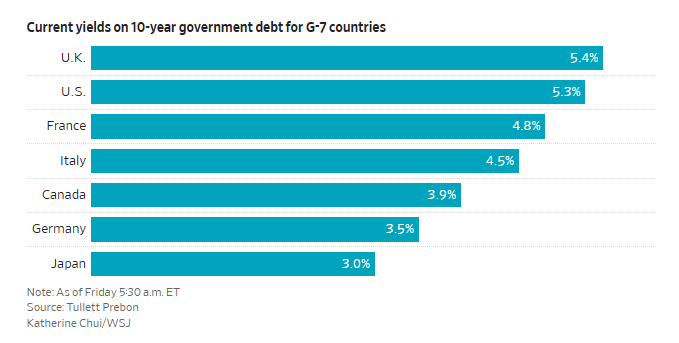
British investors have seen this film before. In 2022, Liz Truss’s unfunded tax cuts set off a gilt rout so violent that the Bank of England had to step in to stabilize pension funds, and she was out of office within weeks. Ever since, every British chancellor has governed in the shadow of the bond market. Today Britain’s 10-year yields are the highest in the G-7. Having flinched once on spending, London now pays a premium every time it borrows, which leaves even less room for the defense increases it has pledged.
France shows the other, and this past week the bill came due in the streets. A government trying to reassure bond investors with €43 billion in spending cuts met days of demonstrations that culminated on Saturday, when some 550,000 protesters filled cities across the country and parts of the protests turned violent. “Public money is scarce,” the prime minister said. The confrontation comes ahead of a presidential election next spring in which support is consolidating at the political extremes, which raises the odds that the next government retreats from the cuts altogether.

Britain retreated from cuts, and the bond market punished it. France is pressing ahead, and the streets are punishing it. That is the dilemma facing every aging democracy that runs large deficits while taking on new defense commitments.
I don’t want to overstate the parallel. The United States has advantages neither country has - the world’s reserve currency, the deepest capital markets, faster growth and an AI boom that, if it delivers, could grow the economy out of some of this. Even so, the U.S. 10-year yield now sits just below Britain’s, and our deficit, near 6% of GDP, is in the same range as France’s. Fink’s bet is that AI-driven growth of more than 3% a year can keep the debt manageable, and it may prove right. The risk is the mirror image. If the boom turns, deficits could balloon just as governments have the least room to respond, and voters already anxious about AI taking their jobs will demand a bigger safety net, not a smaller one.
After November 3, Washington will face these long-deferred trade-offs regardless of which party controls Congress - defense or entitlements, tax cuts or deficit reduction, subsidizing the AI race or letting markets ration it. The bond market eventually asks the question, and it doesn’t wait for a convenient moment.
Eyes Open
None of this argues for slowing AI by fiat, only for financing it with eyes open. If I were advising policymakers, I would start with three principles.
First, treat fiscal space as a strategic asset, which means making the hard choices Washington has deferred. That includes putting Social Security and Medicare on a sustainable footing and spending smarter on defense, favoring the lower-cost systems that deliver more capability per dollar. A credible medium-term path for the deficit, even a gradual one, would do more to lower the cost of capital for AI, housing and defense alike than any Treasury buyback or nudge to corporate issuers. Deficit reduction frees savings for private investment, even if not one for one.
Second, release the right brake and respect the other. Grid and permitting bottlenecks slow everything from data centers to factories to housing, and easing them is good policy whatever happens to AI. People are different. Clinton shows that projects built behind nondisclosure agreements breed the backlash that stalls them, and transparency and a fair share of the benefits cost less than a moratorium. Respecting people also means investing in them. Apprenticeships, trade schools and faster licensing for electricians, linemen and pipefitters would ease a constraint that slows the AI build, the defense buildup and the energy transition at the same time.
Third, keep policy predictable. Part of what investors now demand to hold long-term Treasuries reflects doubts about policy itself, from tariffs to questions about the Fed’s independence. Predictable rules and a central bank insulated from politics cost nothing to provide, and they lower borrowing costs for everyone competing in this cycle. That brings the argument full circle. Every choice in this essay, from how fast to build to how much to borrow, ripples back to the price of capital, and a lower price of capital makes every other choice easier.
For investors, the lessons are older than AI - underwrite the weakest link rather than the average, know who is exposed and to whom, and look for returns that don’t depend on a single factor.
After the Boom
History offers good news and bad news about booms like this one. The good news is that the great capital projects usually delivered what their champions promised, and often more. The canals of 1790s England, the railways of the 1840s and 1880s, electrification, radio, television and the fiber of the dot-com era all left society with something of enormous value. The bad news is that investors were usually disappointed anyway. The benefits arrived later than hoped, profits came smaller and later, or competition passed the gains to users rather than builders. The economist William Nordhaus estimated that innovators in the postwar American economy captured only about 2% of the value their innovations created. Most of the rest went to everyone else.
The railroads are a comparison I find instructive. An investment in a rail safety business first sparked my interest in the industry’s history, and the excellent series on the railway boom and bust that Matt and his co-host produced on Backtest has kept me coming back to it. The pattern is sobering. George Hudson, Britain’s “Railway King,” was ruined when the mania of the 1840s collapsed. In 1873, Jay Cooke & Company, the banking house that had financed the Northern Pacific, failed and helped set off a panic and years of depression. Two decades later, another panic pushed a large share of America’s railroads into receivership. And yet the tracks stayed. The railroads knit together a continental economy and still move a large share of the country’s freight today. The builders and their financiers often went under, but the infrastructure endured. Today’s version moves faster. As Mallaby put it on The Spillover, “even the railroad boom can’t have been quite this crazy,” because modern finance is far deeper, more sophisticated and more retail exposed than anything the railroad barons could tap.
The most useful distinction is between bad bubbles and good ones. The housing bubble of the 2000s was a bad bubble - little innovation, financed mainly by debt, with little of lasting value left behind. The dot-com boom was a good bubble - genuine innovation, financed mainly by equity, whose bust caused only a mild recession and left behind the internet. AI is a hybrid, a transformative technology financed by huge flows of both equity and debt, and there is no clean template for how a hybrid unwinds when governments have little fiscal room to cushion the fall.
Over the next several years, I see three broad paths. In the first, growth outruns the bill - AI revenue and productivity arrive fast enough to justify the capacity and ease the fiscal arithmetic. That is Fink’s path, and it is entirely possible. In the second, the boom is rationed rather than ended - the price of capital and the natural brakes slow the build, the weakest borrowers fail, and the infrastructure still gets built, just more slowly. In the third, a credit event at a weak link collides with a fiscal scare in the bond market. I hope for the first. I believe the second is the most likely, though I think the third is more plausible than markets have been pricing.
The scale of the build and its collision with government borrowing are matters of fact. Whether demand arrives in time to justify it is the open question, and on that question I’d watch the price of money more closely than the price of stocks - spreads on the most leveraged builders’ debt, the premium on long-term Treasuries and whether Japan’s savers keep coming home.
I’ll end where I started, with Larry Fink’s advice in 2007 - read the papers, and understand technology, because it can reshape everything. Nearly two decades later, both point to the same place. AI is real. The defining question of this cycle is how we choose to finance it and what we’re willing to trade for it: lower deficits or faster growth, sovereign capital at home or abroad, the race with China or the consent of a town on the Mississippi. Capital is about choices. I remain bullish on the technology and on America’s capacity to make hard choices when it finally must. But I am paying close attention to who is lending, at what price, and what they are being asked to give up. And I hope our leaders in DC can make some hard choices before the bond markets force them too.
Note: The views expressed here are Will’s own and do not represent those of the Teachers Retirement System of Texas.
