

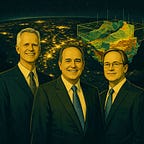
In Part 1, George Mitchell unlocked shale gas. In Part 2, Aubrey McClendon fueled the boom with a capital and land machine at Chesapeake. In Part 3, we tell the story of one of the operators who makes shale production stick. EOG Resources led by CEO Mark Papa cultivates a unique (and uniquely secretive) culture of rigorous capital allocation and constant technical experimentation.
We follow Papa and his lieutenants Bill Thomas and Gary Thomas as they see what others miss: shale’s success in natural gas will eventually create a glut that will crash prices. EOG must pivot to oil or stall. From a dramatic 2007 offsite where Mark tells his team to stop looking for natural gas, to early experiments in the Bakken, to a quietly assembled position in the Eagle Ford, EOG’s edge leads it to become a top US oil producer.
But before they can enjoy their success, the market turns again. On Thanksgiving day 2014, Saudi petroleum minister Ali Al-Naimi announces to the world that OPEC won’t cut production to balance global oil markets. Oil prices collapse by 60% over the next 12 months and the shale boom faces its first true stress test. We unpack why so many companies break—and why EOG doesn’t—ending with the playbook that helped shale survive: low cost operations, productivity gains from technology, focus on premium wells, and operating discipline built to survive boom-bust cycles.
Chapters
(04:56) Two questions: will shale oil work and can shale production be profitable?
(07:28) The operators: Mark Papa, Bill Thomas, and Gary Thomas at EOG
(08:16) The history of EOG
(11:32) The 1990s oil & gas market
(13:34) Two forces converge at Enron in the 1990s
(20:03) Being the low cost operator in commodity businesses
(21:55) Four things that define EOG
(29:32) The commodity supercycle of the 2000s
(33:03) EOG pivots from natural gas to oil
(45:55) EOG announces the Eagle Ford discovery
(55:25) The commodity supercycle and the zero interest rate environment
(57:21) OPEC surprise on thanksgiving 2014
(1:08:04) Lessons learned
References
Saudi America: The Truth About Fracking and How It’s Changing the World by Bethany McLean (Link)
Crude Volatility: The History and the Future of Boom-Bust Oil Prices by Robert McNally (Link)
The Accidental Oilman by Lawrence Strauss, Barron’s, October 2011 (Link)
The Frackers: The Outrageous Inside Story of The New Billionaire Wildcatters by Gregory Zuckerman (Link)
Technological Revolutions and Financial Capital: The Dynamics of Bubbles and Golden Ages by Carlota Perez (Link)


